Nowadays the only people that can actually do a decent Mal-ware analysis are ONLY antivirus research vendors such as Symantec and McAfee. The only thing a Security administrator or an Information Security Consultant can do is Mal-ware behavior analysis. That it is the initial stage of lets say a high profile Mal-ware analysis, but that might not be enough. There are no more than 1000 human beings in this planet that can properly reverse engineer a worm such as Confliker and start writing disinfection tools from scratch (or maybe there are, who knows) or they cannot do it in a reasonable amount if time.
So the next best think from fully reverse engineering a Trojan horse is to do a behavioral analysis and try to confine or mitigate the malicious software. But to me it seems that it is not clear to many people on how to do that or what disinfection really means. For me disinfection means to completely identify how a virus behaves and use proprietary tools to restrain it in such a manner that is going to be no risk.
Lately I was doing some Mal-ware analysis on behalf of a client and I decided to write a mini guide on how to perform a disinfection strartegy. So for the purposes of this article I am going to do a Mal-ware analysis of an MSFPayload executable, why? Because is free, open source point and "single point and click" hacking tool. As already demonstrated in a previous article found here someone can embed a MSFPayload in practically any executable by using free Windows tools that come with default windows installations. So what are the techniques of Mal-ware is using?
Occupy Memory Residency
Memory-resident programs are those that can be placed in, and remain in, an affected system's main memory space after execution. Memory residency enables a piece of malware to be readily available whenever needed, ensuring that the malware is easily accessible or can monitor every event on an affected system. This is a malware's way of controlling every activity on an affected system when a condition is satisfied. To find out if a malware is resident in the memory, you may need to invoke system tools like the Task Manager in Windows NT-based systems. On Windows 95- or 98-based systems, you can press CTRL-ALT-DEL, which displays a window containing all the running processes in memory. Once you have full view of the things that are currently in memory, check if a malware is there or not. This is tricky and at the same time risky. Terminating a memory-resident program that is critical to a system may cause some undesirable results, such as displaying the Blue Screen of Death or even triggering the system to restart. It is advisable to check if a specific memory-resident program is indeed alien to the system, which is not an easy task.
Spoof Process Names
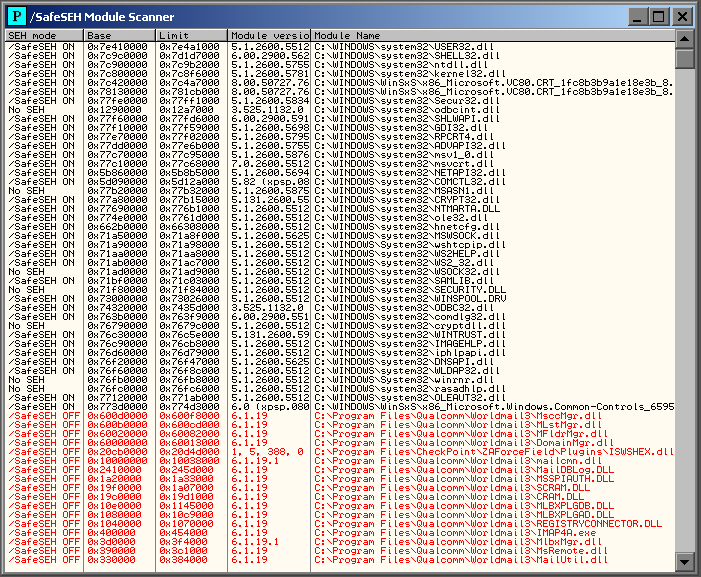
Contemporary malware tends to use process names that look strikingly similar to common process names. For example, WSOCK32.DLL, a common process in memory handling the library of socket functions, can be spoofed as WSOCK33.DLL. Another is KERNE132.dll (notice that the L in KERNEL is actually the number 1) can be mistaken for the real KERNEL32.DLL. Sometimes the names are actually valid but the path is different. The KERNEL32.DLL is always found in the \Windows\System32 directory but some malware puts it in \Windows\System (in the example displayed below you can see how MSFPayload is using mswinsoc.dll).
Alter Start Up locations
Other areas where AutoStart entries can be found are in the files, System.ini and Win.ini. A malware often modifies these with links to itself added to the "run=" or "load=" sections of the files. These files are located at the Windows Directory (typically C:\Windows). Following the same approach that you followed with the registry entries, you can remove them from the AutoStart entries after you have verified that they are malicious. Again, back up these files before making any modification just in case the entries are not malicious and you have to restore the files to their original form. All the necessary system configuration files can be accessed, viewed and edited with the Sysedit program. To invoke the program, click "Start", and then "Run", and then type "Sysedit" in the "Open:" box. Another place where you can find autostart entries are in the Start > (All) Programs > Startup folder. The entries here are also referenced and are executed immediately after system startup. Similarly, you may need to back up these files before tinkering with them. You can also have a look at msconfig wizard to see all services and programs executed from OS.
Malicious Macros
Applications like word processing, spreadsheets or PowerPoint presentations are often vulnerable to macro viruses. You can check for malicious activities by checking for macros within these files. To do this, access the macros organizer (you may refer to your applications help file) and check if there are any unknown macros inside, press the ALT-F11 keys in the more recent offerings of Microsoft Office Family (beginning in Office 97 and up). However, some macro viruses tend to hide themselves from users by changing the foreground/background of the macro font display or by adding multiple tabs to make the text invisible to the default view pane. The following is an explanation of procedures readers can use for two different applications that use macros: MS Word and Excel.
Infected MS Excel Documents
Search your hard drive for any folder name XLStart. For Excel, this folder contains all the things necessary for customization and this includes macros as well. You can transfer the contents of this folder to a temporary directory. Open Excel and turn on the Macro Virus Protection. After doing so, you can now open the Excel file that may be infected and then the Macro Virus Protection should be able to figure that out for you.
What Mal-ware is and how?
Once executed, Mal-ware can perform its intended malicious function on a system. Unfortunately, it may not always be apparent to users that their system is indeed infected. Mal-ware is an ordinary program doing things that should not be doing, nothing more nothing less. I am going to use the same payload I used to do the demo on a previous articles, yep the one called ClickMe.exe. So what happens if we generate an MSFPayload that spawns a Shell and then listens for a connection, what tools should someone use? Well I am using the following tools:
- Process Monitor v3.01 (from SysInternals)
- Fport v2.0 (from McAfee)
- Wireshark v1.6.7 (former Ethereal)
- OllyDbg v 2.0
Using Process Monitor for recording MSFPayload
So lets start with process monitor and try to record the behavior of the malicious file. What I am going to do is first launch the tool, double click on ClickOnMe.exe and then see what can we see from there. When you launch process monitor you can see that there is a filter button, so what I would do is to filter the process image name (we know it is ClickOneMe.exe)

Note: From the drop down list I checked Process Name and by inserting the process image name I filtered the desired executable. Something else someone cold do is to export the results into a CSV file, imported to an excel and do further analysis on how everything happened (time is also included).

Note: Se the XML format you can use, including all this valuable information such as stack trace and stack symbol resolution, and all that with a free tool, amazing ee?
The most interesting feature of this tool is the process activity tool that records all behavior of the process and timeline, just see below the features:

Note: Have a look at the registry activity, the tool is actually parting with the PC. It has totally 257 registry activities, amazing again. It also does some strange file I/O, later on we are going to have some further analysis on how to take advantage of this feature.

Note: This is one of the most interesting feature a process monitoring tool should have because if you click in the button save you can export all registry keys accessed from the process and then write a quick disinfection batch file e.g. deleting all created registry keys from the malicious process by using the command REG DELETE KeyName [/v ValueName | /ve | /va] [/f] from command prompt or what ever tool you use. You can also filter the registry keys associated with the Trojan based on access rights the Mal-ware has (e.g. read, write e.t.c) usually a Mal-ware is running on users permissions.
Another very cool feature of the tool is the file monitoring capability it has. Process Monitor can actually record all file accessed, modified and used by the Mal-ware while running, filtered per path, extension, and folder name:

Note: See the tool differentiating, how the Mal-ware treats WINDOWS, Prefetch and System32 system files. Metasploit has done a good job optimizing the behavior of MSFPayload utility. ClickOnMe.exe generates even a prefetch to optimize it behavior.
Prefetcher as MSFPayload Mal-ware accelerator
The Prefetcher is a component of versions of Microsoft Windows starting with Windows XP. It is a component of the Memory Manager that speeds up the Windows boot process, and shortens the amount of time it takes to start up programs. In Windows Vista, SuperFetch and ReadyBoost extend upon the prefetcher and attempt to accelerate application and boot launch times respectively by monitoring and adapting to usage patterns over periods of time and loading the majority of the files and data needed by them into memory so that they can be accessed very quickly when needed. When Mal-ware is using prefetch then it can optimize it's performance.
Suspicious dll files loaded by MSFPayload
One of the not so few dll files that our MSFPayload loads implies that network activity is happening from the Mal-ware. If you click to expand the plus sign in system32 you will see that mswsock.dll is used by the Mal-ware which means that an outbound connection was attempted. Winsock dll is a windows socket library. One of the many interesting function implemented in Winsock.dll is the gethostbyname which by the way is deprecated. The function mentioned tells us that our Trojan can do a DNS address resolution and sent probably personal data (of course we would have to be sure what function is used).
Suspicious files loaded by MSFPayload
Now if you check the AppPatch windows file system you will see that SysMain.sdb was used, which contains both matching information and compatibility fixes per application. It can be found in the %Windir%\AppPatch directory.
Using FPort for recording MSFPayload
Fport is used to identify unknown open ports and their associated applications. FPort supports Windows NT4, Windows 2000 and Windows XP, it reports all open TCP/IP and UDP ports and maps them to the owning application. This is the same information you would see using the 'netstat -an' command, but it also maps those ports to running processes with the PID, process name and path. Fport can be used to quickly identify unknown open ports and their associated applications. Someone could use FPort to take periodically snapshots from the system your are trying to disinfect and that way record all connections from a possibly malicious software (you can add a task scheduler). The output of FPort concerning the ClickOnMe.exe is:
FPort v2.0 - TCP/IP Process to Port Mapper
Copyright 2000 by Foundstone, Inc.
Pid Process Port Proto Path
3268 ClickOnMe -> 2565 TCP C:\Documents and Settings\jerry\trojan\ClickOnMe.exe
3268 ClickOnMe -> 9000 UDP C:\Documents and Settings\jerry\trojan\ClickOnMe.exe
Note: See that the MSFPayload uses both TCP and UDP.
Using Wireshark for recording MSFPayload
Wireshark is the world's foremost network protocol analyzer. It lets you capture and interactively browse the traffic running on a computer network. It is the de facto (and often de jure) standard across many industries and educational institutions. Wireshark development thrives thanks to the contributions of networking experts across the globe. It is the continuation of a project that started in 1998.
We canuse Wireshark to record the MSFPayload and see how the payload looks like in the wire. When the ClickOnMe.exe tries to spawn a reverse shell to the attacker and then start listening for a connection (meaning it binds a shell to the desired port). So lets see what it does it. This is how start listening for all packets by selecting my network card (click to enlarge):

Note: This is how you start listening the net-card. Because tons of tutorials exist out there about Wireshark I am not going to waste more time on Wiresharking the MSFPayload.
Using OllyDebug for recording MSFPayload
OllyDbg is a 32-bit assembler level analyzing debugger for Microsoft Windows. Emphasis on binary code analysis makes it particularly useful in cases where source is unavailable. OllyDbg is a shareware, but you can download and use it for free.With OllyDbg you can analyze all sorts of Mal-ware and verify information that you collected from other software.
So what I would do is to launch MSFPayload and the attack the process and this is what you get:

Note: The process terminates immediately after it launches, but that is the stack footprint we get from OllyDebugger.
Further investigation with Olly Debugger will reveal all engaged dll used from the MSFPayload (click to enlarge):

Note: You can see that the screen shot from above verifies the result from process monitor, again it reveals that mswsock.dll is used so a data confidentiality issue is what you should be looking for.
Using Olly Debugger can help you extract valuable hidden text about what the executable might be doing. In this occasion we could actually see from some ASCII dumps that the Mal-ware is connecting to something:
Address ASCII dump
0040D230 C:H:P:A:g:X:de:Sq bgcolor=whit
0040D250 e Total of %d requests complet
0040D270 ed
%s
..done
Finished %d requ
0040D290 ests
apr_socket_connect()
0040D2B0
Test aborted after 10 failures
0040D2D0
Server timed out
apr_poll
0040D2F0 apr_sockaddr_info_get() for
0040D310 %s error creating request buffe
0040D330 r: out of memory
INFO: %s hea
0040D350 der ==
---
%s
---
Request too
0040D370 long
%s %s HTTP/1.0
%s%s%sCo
0040D390 ntent-length: %u
Content-type:
0040D3B0 %s
%s
PUT POST text/pla
Note: From the HTTP/1.0, PUT and POST keywords we can understand that the Mal-Ware is using Http to communicate with the attacker. We also know that Meterpreter payload is using http to communicate with the attacking machine. Show by going through these type of details we can find a lot of hidden information and make almost certain the connect back IP. We can even identify how many failed connection it will do until it stops trying to connect back to some IP.
The text shown below shows how it might be constructed our executable:
http://www.zeustech.net
0040E9C0 /<br>
This is ApacheBench, Ve
Note: If we Google zeustech.net we will find that is a company with traffic manager appliances. Now if we Google ApacheBench (ab) we will find out that is a single-threaded command line computer program for measuring the performance of HTTP web servers. Originally designed to test the Apache HTTP Server, it is actually generic enough to test any web server.The ab tool comes bundled with the standard Apache source distribution, and like the Apache web server itself, is free, open source software and distributed under the terms of the Apache License.
Detecting Mal-ware through ApacheBench signature
Using the above information we can use industry antivirus software to build costume IPS and AV signatures:
Example Usage (taken from Wiki):
ab -n 100 -c 10 http://www.something.com/
This will execute 100 HTTP GET requests, using 10 threads (10 requests per thread) to the specified URL, in this example, "http://www.yahoo.com". If someone goes to the relevant web page can actually find out about a the little details. So my assumption is that Metasploit is using Apache Bench some how to generate the shellcodes.There is a very interesting google-code project about Apache Bench you can find here.
Finally Removing The Mal-ware
OK we identified the Mal-ware, we found all the changes the Mal-ware did to our system now what? Well the question is relatively easy, you remove the virus. The process of doing that is pretty much easy. First you record all changes through the tools we described then you export the results in CVS format and import them into the excel you process the data e.g. identify new malicious registry keys, maliciously generated files e.t.c. After we do that we generate a Vb-script or a batch file performing the necessary actions to remove the virus. You can actually automate this process by writing an excel file that spits the desired Vb-script or use batch files using macros or you can simple use a bash script to do that by using various delicious tools. The Vb-script or a batch skeleton should consist of 4 sections:
[Section 1]
The Registry Key section (we do removing or deleting keys):
- Registry keys to delete.
- Registry keys to write.
The File/Folder Section (we do removing or restoring files/folders):
- Malicious files/folders to delete.
- Malicious files/folders to restore.
The Process Section (we do process killing):
- Malicious process to kill (kill process with the desired process image name).
- Malicious service to kill (kill service and make sure it does not restart).
The Network Section (we do network activity killing):
- Malicious Network activity to block ( e.g. Write costume signatures for host based IPS)
- Malicious Network activity to record (e.g. Write costume signatures for host based IDS)
Epilogue
I proved once more that with freeware tools you can do lots of interesting stuff and one of them is Mal-ware analysis.
References:
- http://www.wireshark.org/
- http://www.mcafee.com/us/downloads/free-tools/fport.aspx
- http://technet.microsoft.com/en-us/sysinternals/bb896645
- http://www.computing.net/answers/programming/delete-a-registry-key-with-batch/8218.html
- http://en.wikipedia.org/wiki/Prefetcher
- http://msdn.microsoft.com/en-us/library/windows/desktop/ms738524%28v=vs.85%29.aspx
- http://en.wikipedia.org/wiki/ApacheBench
- http://www.symantec.com/connect/articles/are-you-infected-detecting-malware-infection
- http://code.google.com/p/apachebench-standalone/wiki/HowToBuild